

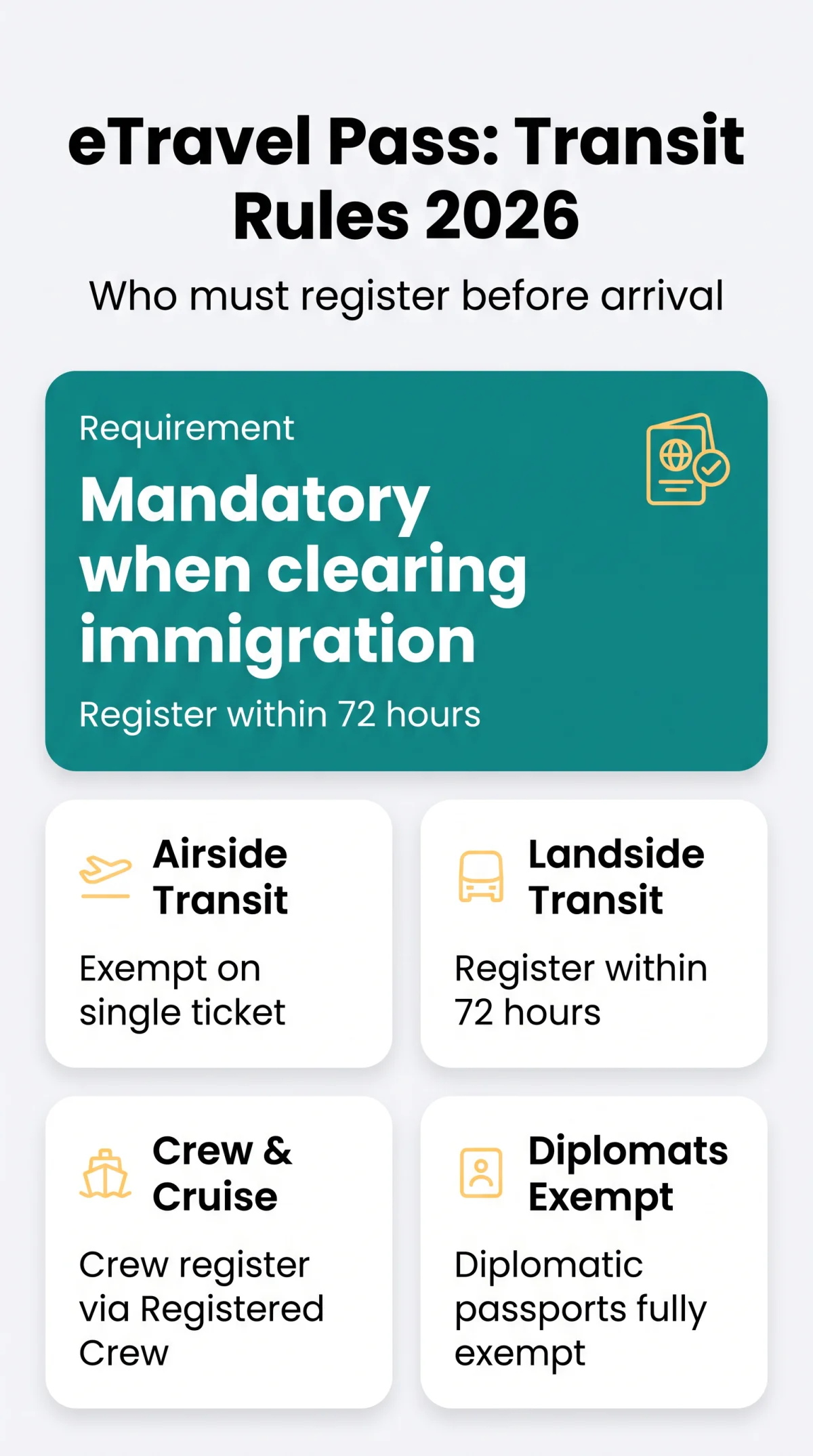
Yes, the Philippines eTravel Pass is mandatory for transit passengers who clear immigration or move landside, for example, self-connecting travellers with separate tickets. However, passengers who remain airside on a single itinerary do not need to complete eTravel. Crew members, cruise travellers disembarking at ports, and most visitors, including athletes, must register via etravel.gov.ph within 72 hours of departure. Only diplomats with valid credentials are fully exempt.
The Philippines eTravel Pass is mandatory for transit passengers who clear immigration or move landside, but exempt for airside transit on a single itinerary. Airline and ship crew arriving in the Philippines must register via the dedicated Registered Crew module on etravel.gov.ph. Only diplomats holding valid diplomatic or service passports are fully exempt from the eTravel requirement.
For travellers asking, “Is the eTravel Pass Philippines mandatory for transit passengers?” the answer depends on your itinerary. If your layover at NAIA or Clark keeps you within the international transfer zone on a single ticket, you do not need to register. Self-connecting travellers with separate bookings and anyone passing through border control must complete the Philippines eTravel Pass within 72 hours before departure.
What Is the Philippines eTravel Pass?
The Philippines eTravel Pass is a free digital travel declaration system hosted at etravel.gov.ph, mandatory for all arriving passengers. If you are new to the system, read our complete guide to the Philippines eTravel Pass. It replaces the former paper arrival cards and consolidates the Electronic Health Declaration Card (eHDC), mandated by the Bureau of Quarantine (BOQ), with immigration pre-clearance data into a single platform.
The Philippines eTravel Pass operates under the Ease of Doing Business Law (R.A. 11032) and is free of charge. The only official website is https://etravel.gov.ph; a .gov.ph domain confirms authenticity. Available via web or the eGovPH mobile app. As of 2026, the platform remains mandatory with no announced plans to discontinue, and a dedicated Cruise Travel Registration QR code portal has been introduced for cruise-specific registration.
Registration is mandatory for all arriving passengers (Filipino and foreign) and for departing Filipino nationals. Departing foreign passengers are exempt. The platform serves border control, health surveillance, and economic data analysis at every Philippine port of entry.
Do Transit Passengers Need the eTravel Pass?
Transit passengers staying airside on a single ticket do not need the Philippines eTravel Pass, but self-connecting passengers clearing immigration must register before departure.
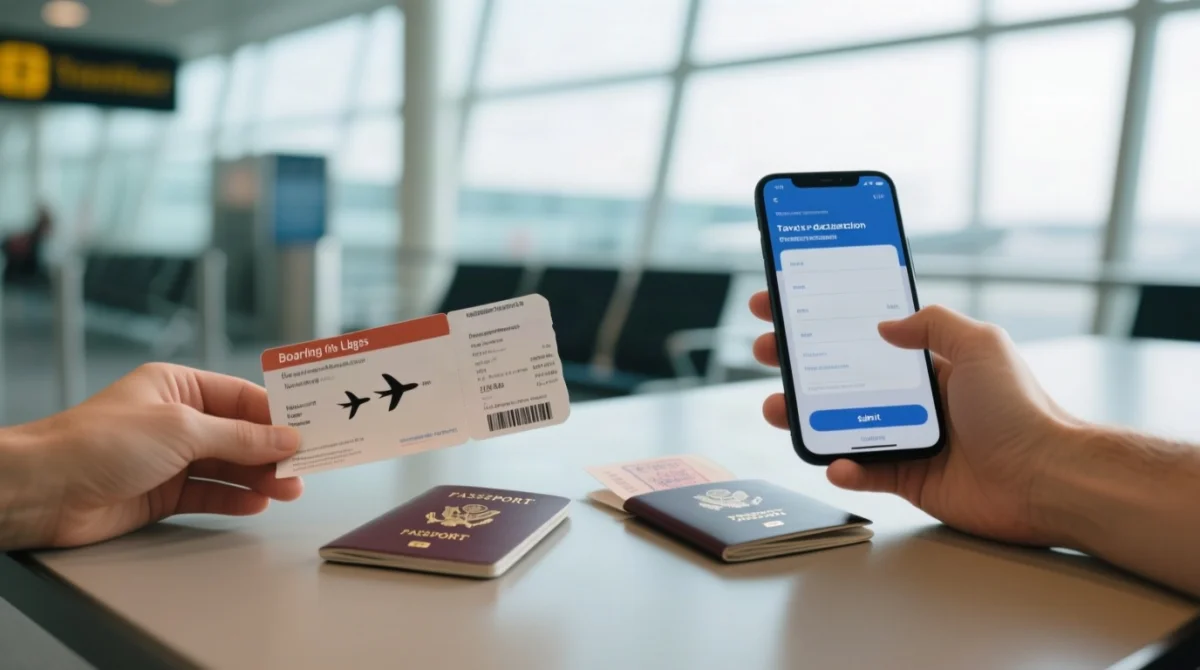
Airside Transit: When You Are Exempt
The Philippines eTravel Pass does not apply to transit passengers holding a single ticket / PNR who stay within the international transfer zone at NAIA or Clark without passing through immigration. Even passengers using an airside transit hotel such as The Wings at NAIA Terminal 3 remain exempt, provided they do not cross immigration control. Holders of a 9(b) transit visa who remain airside are also exempt from eTravel, as the visa and the eTravel registration are separate systems governed by different agencies.
Landside Transit: When eTravel Is Mandatory
The Philippines eTravel Pass becomes mandatory the moment a transit passenger clears immigration. This applies to self-connecting travellers on separate bookings, passengers changing terminals at NAIA (e.g. Terminal 1 to Terminal 3) where no airside shuttle forces immigration clearance, and anyone taking an overnight layover at a landside hotel. Registration must be completed within 72 hours before arrival via etravel.gov.ph. For more details on timing, check our guide on the 72-hour validity rules. Transit Without Visa (TWOV) rules are distinct from eTravel: TWOV governs whether a non-visa-exempt national may leave the airport, while eTravel governs the digital health and immigration declaration required at the port of entry.
Crew, Cruise Travellers, and eTravel Requirements
All arriving airline and ship crew must register through the Registered Crew module on etravel.gov.ph, while cruise passengers disembarking for shore excursions must submit individual eTravel declarations.
The Philippines eTravel Pass is mandatory for all arriving crew members, both Filipino and foreign. This includes deadheading or positioning crew, who must use the crew module rather than the passenger module. Ship crew arriving at any port of entry face the same obligation. Previously registered crew use the “Registered Crew” tab to update. On departure, the Philippines eTravel Pass is mandatory for Filipino crew; departing foreign crew are exempt.
Cruise Travellers: What You Need to Know
Cruise passengers who disembark at a Philippine port of entry, whether for a shore excursion or a port-of-call stop, must submit an individual eTravel registration for each port visit. Passengers who remain onboard while the ship is in port are exempt. Cruise crew access registration through the dedicated Cruise Travel Registration QR code portal available on etravel.gov.ph, which collects vessel information and passenger details specific to cruise arrivals.
Diplomats, Athletes, and Special Exemptions
Diplomatic and service passport holders are exempt from the Philippines eTravel Pass, but athletes and sports delegations must register unless holding diplomatic credentials.
The Philippines eTravel Pass exempts the following categories from registration: foreign diplomats, dependents of foreign diplomats, foreign dignitaries, members of foreign dignitaries’ delegations, 9(e) visa holders, and diplomatic, official, or service passport holders. Athletes and sports delegations are not automatically exempt. Unless an athlete holds a diplomatic or official passport, the Philippines eTravel Pass must be completed as a standard arriving foreign passenger. Event organisers may arrange group facilitation with the Bureau of Immigration, but no blanket exemption exists in current BI guidelines. Children travelling with family must have individual eTravel registration, even when registered alongside parents. You can read more about child eTravel registration requirements in our dedicated family guide.
The 72-Hour Rule: Registration Timing and QR Code
eTravel registration must be completed within 72 hours before departure, and the resulting QR code is required at airline check-in.
Registration must be submitted within 72 hours (3 days) prior to arrival in or departure from the Philippines. Proof of the Philippines eTravel Pass must be presented to an airline representative prior to boarding; accepted formats include screenshot, downloaded file, or printed copy. A green QR code means data is complete and the traveller proceeds directly to immigration. Learn how to download your eTravel QR code to ensure smooth processing. A red QR code triggers further inspection by the Bureau of Quarantine (BOQ) before immigration formalities. If flight details change, update your registration via the “Edit Registration” tab on etravel.gov.ph, as the QR code is linked to your flight itinerary. See our step-by-step instructions on how to change flight details on your eTravel Pass. Present only one QR code during inspection. Failure to present a valid QR code at check-in may result in denied boarding.
The Philippines eTravel Pass is free of charge. Any website demanding payment is fraudulent. Report scams to the CICC at cicc.gov.ph/report.
This article was last verified against official guidelines on etravel.gov.ph in September 2026. Regulations may change; always confirm with the BI hotline or your airline before departure.
FAQ: eTravel Pass Requirements for Transit, Crew, and Special Categories
Is the eTravel Pass Philippines mandatory for transit passengers who remain airside at Manila?
No. Single ticket, airside at NAIA or Clark means exempt. Clearing immigration for any reason makes registration mandatory within 72 hours before arrival.
What is the difference between airside and landside transit for eTravel purposes?
Airside means within the international transit zone without immigration. Landside means entering the Philippines via border control. Airside on a single PNR is exempt; landside requires registration.
Are cruise ship passengers required to submit an eTravel Pass before docking in the Philippines?
Yes. Disembarking passengers must submit individual eTravel per port call. Those remaining onboard during a transit-only stop are exempt.
Does airline crew need to register for eTravel when arriving in the Philippines?
Yes. All arriving crew, Filipino and foreign, must use the Registered Crew tab on etravel.gov.ph. Departing foreign crew are exempt; departing Filipino crew must register.
Do seafarers and ship crew need to complete eTravel when disembarking at Philippine ports?
Yes. Ship crew must complete eTravel before arrival. Deadheading crew must use the crew module, not the passenger module.
Are diplomats exempt from the eTravel Pass requirement?
Yes. Diplomatic, official, or service passport holders, foreign dignitaries, their delegations, and 9(e) visa holders are exempt, confirmed on etravel.gov.ph under current BI guidelines.
Do athletes and sports delegations visiting the Philippines need eTravel in 2026?
Yes. Athletes are not automatically exempt. Unless holding a diplomatic or official passport, they must register as standard arriving foreign passengers.
Can I complete the eTravel Pass at the airport if I forgot to register before my flight?
Possible on arrival if Wi-Fi or a kiosk is available, but risky. Airlines check for the QR code before boarding and may deny boarding without it.
What happens if the eTravel system goes down? Are paper arrival cards still accepted?
Not officially documented by BI. Airlines may accept manual processing at their discretion. Always pre-register within 72 hours and carry a screenshot of your QR code offline.
Is the eTravel Pass the same as a Philippine transit visa?
No. eTravel is a digital health and immigration declaration. A transit visa (9(b)) is a separate immigration document. Both may apply if you clear immigration.